|
|
本帖最后由 mynameismo 于 2015-4-20 18:20 编辑
个人感觉很棒的一篇文章,有理有据,分享给大家,内容有些长,好研究的鱼友可以一起讨论,翻译不妥之处请指证。原文出处http://www.advancedaquarist.com/2012/10/aafeature
目录
一、海水中的光谱分布
二、珊瑚显色的成因—色素蛋白--5楼
三、人眼的视觉特性--6楼
四、珊瑚的荧光发色特性--7楼
五、光强对于珊瑚显色的影响--8楼
六、LED的优势---15#、16#
七、光的色彩特性--17#、18#
八、LED灯光谱配置--19#、20#
一、海水中的光谱分布
Perhaps every reef hobbyist is willing to provide the "right" light to his corals - both correct spectrum and sufficient intensity are important. Before we consider how to implement this "right light," we shall first try to understand what kind of light marine organisms get in their natural environment.
As our starting point, consider the spectral distribution of solar energy in Fiji in July, Fig. 1:
也许每一个礁岩爱好者愿意提供“正确”的光给他的珊瑚-正确的频谱和足够的强度是重要的。在我们考虑如何实施这一“正确的光”,我们要先了解海洋生物在自然环境中是什么样的光。
我们从七月斐济的日光光谱出发讨论以下问题
Fig. 1 Spectral distribution of sunlight energy at the level of the sea
图1光能量在海中光谱分布
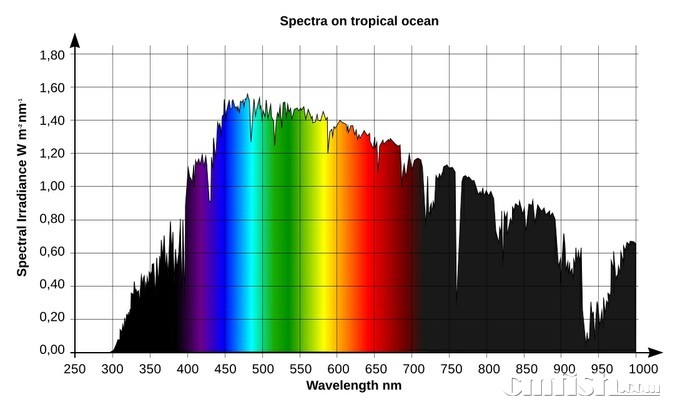
The horizontal axis of the graph is wavelength, in nanometers, and the vertical axis is spectral irradiance, in W/m2·nm. The human eye is sensitive to radiation in the range between approximately 400 and 700nm, therefore we marked the wavelength ranges shorter than 400nm (ultraviolet light) or longer than 700nm (infrared radiation) in black, whereas visible wavelengths are colored as they are perceived by the eye.
The chart in Fig. 1 has been obtained from the solar spectrum at the boundary of the earth atmosphere using the SMARTS 2.9.5 scientific simulation software. This simulator takes into account light absorption by various components of the atmosphere as well as scattered light from the sky.
该图的横轴是波长,纳米,纵轴是光谱辐照度,单位:W /平方米·nm。人类的眼睛是在约400和700nm范围辐射敏感,因此我们把短于400nm波长范围(紫外线)或大于700nm(红外辐射)显示为黑色,而可见光波长的颜色也由眼睛感知。
图1中的图是使用SMARTS 2.9.5科学仿真软件模拟边界的地球大气层的太阳光谱。该模拟器考察大气中各种成分的吸收光以及散射光。
Let us now try to find out what kind of light spectrum is available to marine organisms in their natural environment. In our attempt to build an ideal light fixture for our reef tanks we shall try to generate a similar spectral distribution at certain depths underwater.
现在让我们尝试找出什么样的光谱在自然环境中可对海洋生物是适宜的。当我们想要试图为礁岩缸建立一个理想的灯具时,我们需要在一定深度的水下生成一个类似的光谱分布。
Different coral species live on various depths: some live in very shallow waters, whereas deep water corals, such as Bathypates spp., can be found on the depths of up to 8000 meters (about 5 miles). About 20% of all coral species are non photosynthetic; they do not require any light as a food source. Most corals, however, are photosynthetic, and these are the species which are kept most often at home aquaria. We shall try to figure out what kind of light they prefer.
不同的珊瑚物种生活在不同深度:一些生活在很浅的水域,而深水珊瑚,如bathypates属,可在深达8000米的深处(约5英里)。大约20%的珊瑚物种是非光合的;他们不需要任何光作为食物来源。然而,大部分的珊瑚是光合的,这些是在家庭中最经常被饲养的物种。我们将尝试找出他们喜欢什么样的光。
Consider the graph of solar light penetration into marine water, depending on wavelength, compiled by the Institute for Environment and Sustainability of the European Commission [4] (Fig. 2):
太阳光穿透海水的光谱图,根据波长来绘制(横轴是波长),通过环境与欧盟委员会[ 4 ]可持续发展研究所编制的(图2):
Fig. 2 Penetration of light into seawater, depending on wavelength
太阳光穿透海水后的光谱图,根据波长来绘制(横轴是波长)

The horizontal axis is the light wavelength, in nanometers, and the vertical axis is depth, in meters, at which the intensity of that wavelength is equal to one percent of the intensity at the surface. It is clear from this graph that wavelengths between approximately 370 and 500nm best penetrate into the depth. In other words, violet and blue parts of the spectrum penetrate best into seawater, whereas green light is much worse at that, yellow-orange is even worse, and red light with wavelengths longer than 600nm is only capable of penetrating very shallow waters.
水平轴是光的波长,单位nm,垂直轴是深度,单位米,在该深度的水下光强等于水面百分之一的强度。从图上看出在约370和500nm的波长有最佳穿透力。换句话说,紫色和蓝色的部分更容易穿透海水,而绿色光穿透力较弱,黄橙光更弱,而波长600nm是唯一能够穿透很浅的水深红光。
The light spectrum on the surface can be defined as a function I0(λ), where λ is the wavelength and I0 is the intensity for corresponding wavelength at zero depth. Hence the adsorption spectrum Ia(λ) at the depth D can be determined as
Ia(λ) = I0(λ) · K(λ) · D (1)
where K(λ) is the adsorption by marine water as a function of wavelength.
The spectrum at the depth D will be equal to the spectrum on the surface I0(λ) minus the adsorption spectrum Ia(λ):
I(λ) = I0(λ) - Ia(λ),
or, by substituting (1) into this expression, we shall derive:
I(λ) = I0(λ) · (1 - K(λ) · D) (2)
From this expression we can derive the graph of light penetration into seawater d(λ):
d(λ) = (1 - I(λ) / I0(λ)) / K(λ)) (3)
Providing that the graph in Fig. 2 is based on the assumption that light intensity on the specified depth is equal to 1% of the intensity on the surface, i.e. I(λ) = 0,01 · I0(λ), we can simplify (3):
This function d(λ) is our graph of light penetration into seawater, which is pictured in Fig. 2. Using this graph we can determine light adsorption in seawater as a function of wavelength K(λ):
K(λ) = 0.99 / d(λ) (4)
By substituting the expression (4) into (2), we can derive the spectral distribution of light at a given depth D:
I(λ) = I0(λ) · (1 - 0.99 · D / d(λ)) (5)
where I0(λ) is the light spectrum on the surface and d(λ) is the graph of light penetration into seawater (Fig. 2).
这一大段大意是说:作一个假定:某一深度的下的光强是海水表面光强的百分之一,经过一番推导,得出I(λ) = I0(λ) · (1 - 0.99 · D / d(λ)) (5)
其中:I(λ)是关于波长λ在某一深度下的光强,I(λ)的函数曲线即为某一深度下的光谱图
I0(λ)是在水面上(深度为0米)的光强函数,I(λ)的函数曲线即为水面上的光谱图
D为海水深度
d(λ)为特定波长的光所能穿透海水深度
Using the expression (5) and the data from graphs in Fig. 1 and Fig. 2, we can obtain the diagram of light energy distribution vs. wavelength at a given depth. As an example, on the same graph (Fig. 3) we pictured light's relative spectral distribution at the surface and at the depths of 5m (about 16.4 feet) and 15m (49 feet). Note: 15m is the maximum depth at which we can still find many light-demanding corals in nature. At the depths below 20m, the number of light demanding species sharply decreases.
使用表达式(5)及图1和图2图的数据,我们得到特定深度下波长与获取光能的关系图。作为一个例子,在同一张图(图3)我们绘制光在表面和在5m深处(约16.4英尺)和15米(49英尺)的相对光谱分布图。注:15m是我们仍能找到许多对光有苛刻要求的珊瑚在自然界的最大深度。在深度低于20m,需光物种数量急剧下降。
Fig. 3 Light spectral distribution vs. wavelength on the surface (light blue), at 5m (blue) and 15m (dark blue) depths
图3 在水面上的(浅蓝色)光谱分布图,在5m(蓝色)和15m深度(深蓝色)光谱分布图

The light-blue graph corresponds to irradiation on the surface, the blue graph - to 5m depth, and the dark-blue - to 15m depth. Note that with depth, the red part of the spectrum virtually disappears.
图3 在水面上的(浅蓝色)光谱分布图,在5m(蓝色)和15m深度(深蓝色)光谱分布图
淡蓝色的图对应的水面上光谱分布,5m深度是蓝图光谱分布,深蓝色是15m深度光谱分布。注意在深水中,光谱中的红色部分几乎消失。
During hundreds of millions years of evolution marine photosynthetic organisms adapted to best utilize mainly the violet and blue parts of the spectrum, which is more abundant in their environment, and are not very sensitive to the red spectrum (which, in contrast, is most actively utilized by terrestrial plants). Symbiotic zooxanthellae in marine photosynthetic organisms are primitive Pyrrophyta algae [5] containing mainly chlorophyll a and c and carotenoid pigments (peridinine, xanthins, etc) which exhibit strong absorption in the blue-green part of the spectrum. [6,7,22]. Fig. 4 [22] demonstrates light adsorption by zooxanthellae.
在数百万年进化中,海洋光合生物形成了主要使用光谱段中紫光和蓝光(这些光在水中更充足)的适应性,而对红光不太敏感(而红光被陆地植物最大化的利用)。海洋光合生物共生藻是原始的Pyrrophyta algae[ 5 ],它含有叶绿素A和C 并且是 Carotenoid的主要色素成分(peridinine,xanthins等),Carotenoid在蓝绿色光谱段具有极强的吸收能力。[ 6,7,22 ]。(译者注:吸收能力强的波段会形成峰值)
Fig. 4 Light absorption by zooxanthellae
图4 [ 22 ]共生藻吸收光分布图。

The horizontal axis is the wavelength, in nanometers, and vertical axis is adsorption, in arbitrary units. You can see from the graph that violet and blue colors strongly prevail over red (note that for red spectrum, the 660-680nm range is preferable).
水平轴是波长,单位nm,纵轴是吸附能力,为相对单位。可以从图中看到,紫色和蓝色段要远多于红色(注意红色光谱的范围,660-680nm段较多)。
Our main conclusion from the above is that violet and blue light are most important for marine photosynthetic organisms.
我们从以上得出的主要结论是,紫色和蓝色光的海洋对光合生物最重要。 |
|
 [复制链接]
 |Archiver|手机版|小黑屋|海友网CMF
( 琼ICP备12003277号 )
|Archiver|手机版|小黑屋|海友网CMF
( 琼ICP备12003277号 )


 发表于 2015-4-17 17:12:49


 楼主
楼主


